We speak a lot about interventions when nudging teams along their team effectiveness journeys. But what are we really aiming for here? Interventions alone and just for the sake of doing something are not enough. We need our interventions to also be strategically placed at the right leverage points. In other words, we need strategic interventions.
The first step towards making strategic interventions is to actively observe your team in a holistic and objective way. This requires structure. Without structure, our observations are more prone to bias and thus less helpful.
In this post we introduce our Holistic Observations of Teams Framework that we’ve been using when observing teams. We go through some examples and also break it down in more detail below.
Consider the difference between the following two coaching interventions.
Same team, Different interventions, Different impacts
Coach A observed that a team was not doing product discovery. Coach A believes product discovery is important, so they taught the team how to do it.
Coach B, like Coach A, also observed that the team was not doing product discovery. After some exploration, Coach B discovered that disabling legacy code was the culprit. Together, they developed principles that would help them reduce their technical debt. This freed up time for other activities such as product discovery.
Coach A stopped at a surface level observation. This is often insufficient for basing an intervention. Coach B explored the underlying reasons and made an important discovery. Through this, Coach B was able to implement a strategic intervention and have a meaningful impact with the team.
Why a framework to observe teams?
Over the years, we’ve combined and turned out insights from Tuckman, Wheelan, and Hackman and Wageman’s work into this framework. This has helped us think through complex issues in a more structured way.
Like it has for us, the Holistic Observations of Teams Framework may help you:
- Understand areas you’re actively observing
- Identify what you may be disregarding
- Gain new insights about your team through actively observing more or other areas
- Map interventions with observations, helping you discover when you’re acting on real needs.
The Holistic Observations of Teams Framework
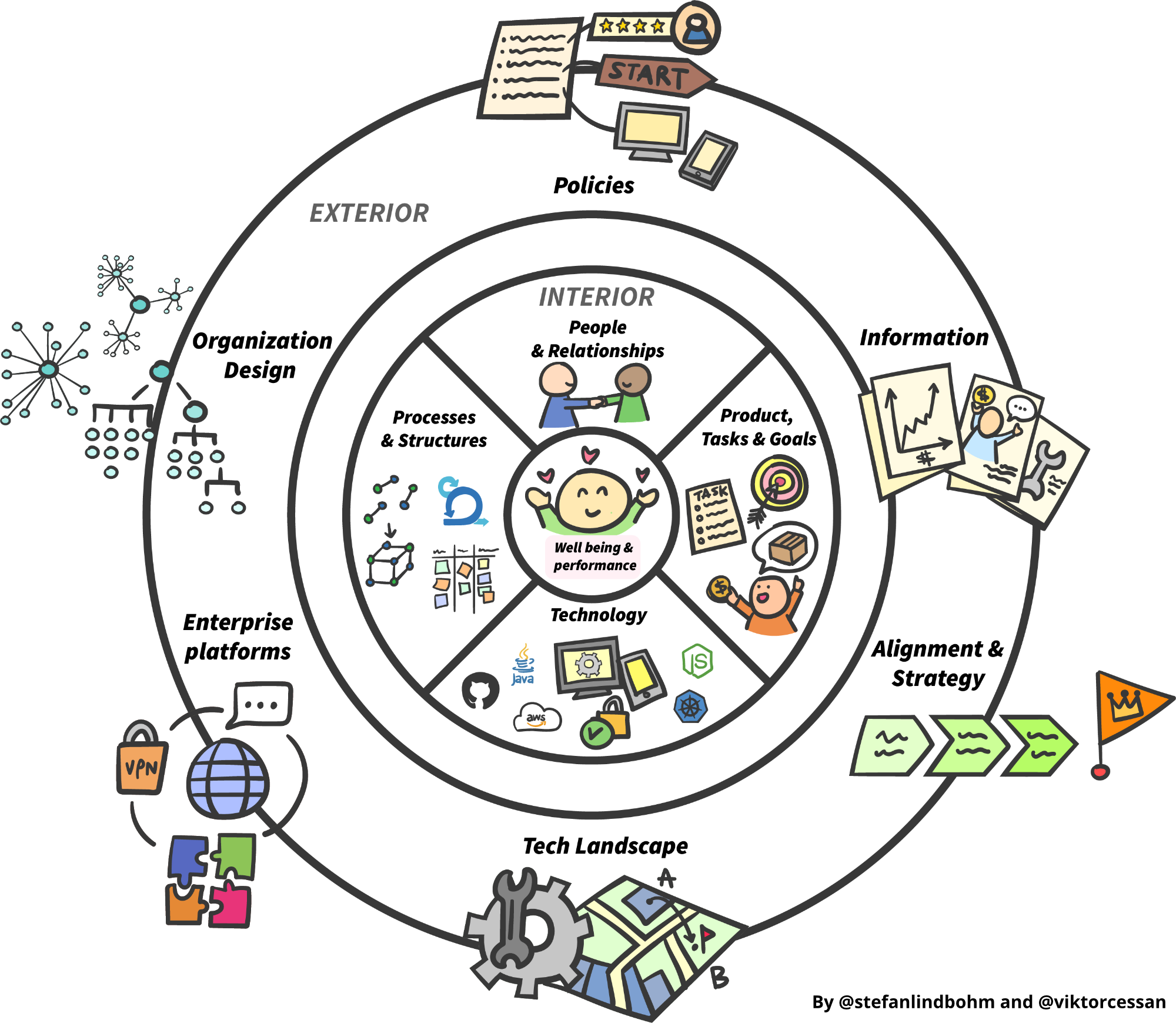
At the center of the framework is team well-being and performance. All interventions we make as coaches and managers must be in support of improving these two aspects of a team.
Many factors affect well-being and performance, however. These factors can come from both within and outside the team. Thus, we need to consider both the Interior and Exterior Perspective.
Interior Perspective
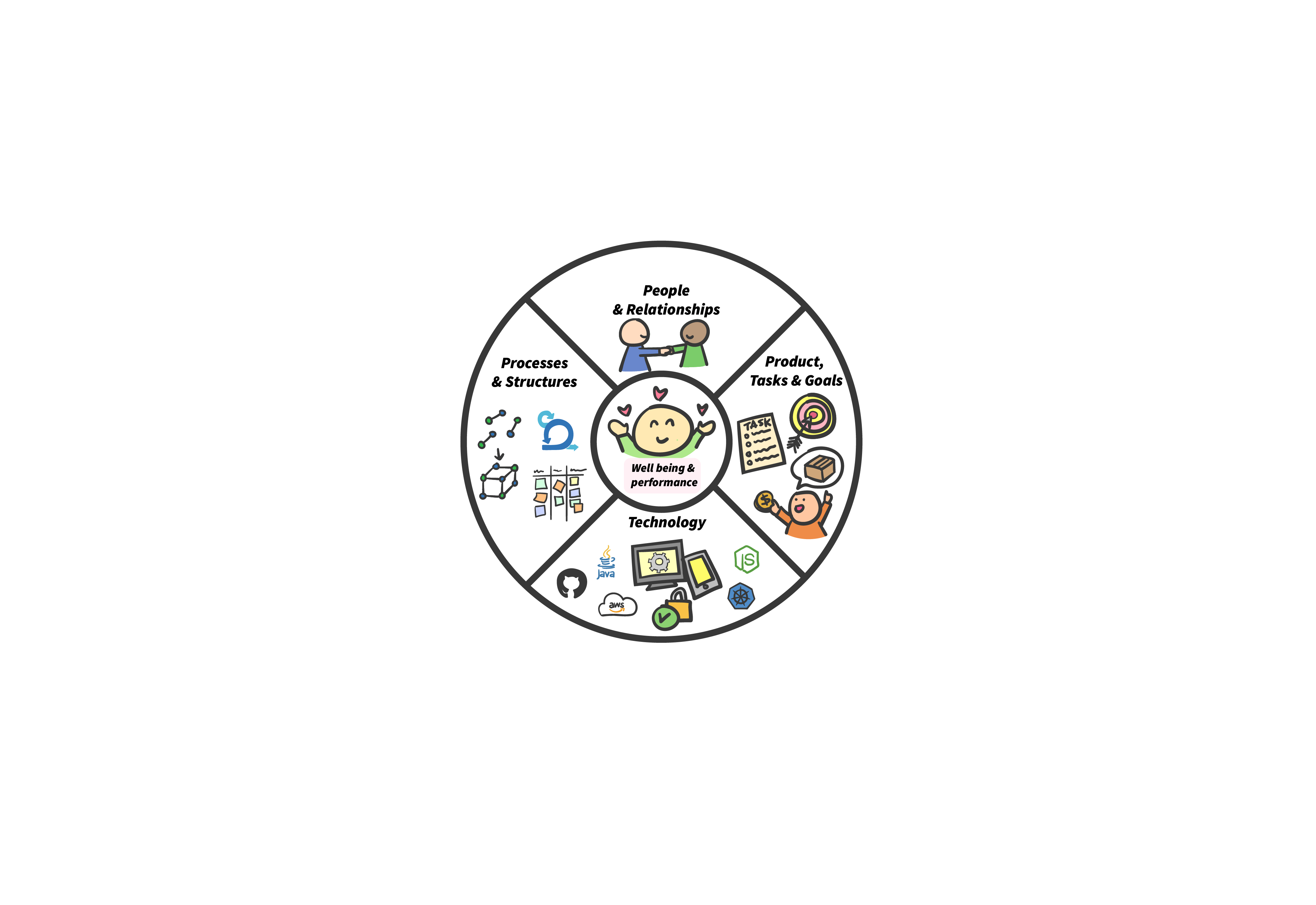 The Interior Perspective considers everything happening within the team. For product teams, these can be categorized into four general focus areas:
- People & Relationships. E.g. Trust and safety, empathy towards each other, inclusion, growth, conflict resolution, and staffing.
- Product (including tasks and goals). E.g. Purpose and mission, strategy, metrics, goals, results, value exchange system, customer needs/problems, market conditions etc.
- Processes and Structures. E.g. Way of working, roles and expectations, decision making style, how work is visualized, how work is divided and shared, what meetings exist and for what reason
- Technology. E.g. Scalability, stability, general performance, technical ecosystem, quality, technical ecosystem, release platform.
When observing the team, consider how the team acts within each area. E.g. how does the team ensure inclusion (if they even do that)? What is the team’s understanding of the market conditions? Are there metrics to work with? And so on.
Exterior Perspective
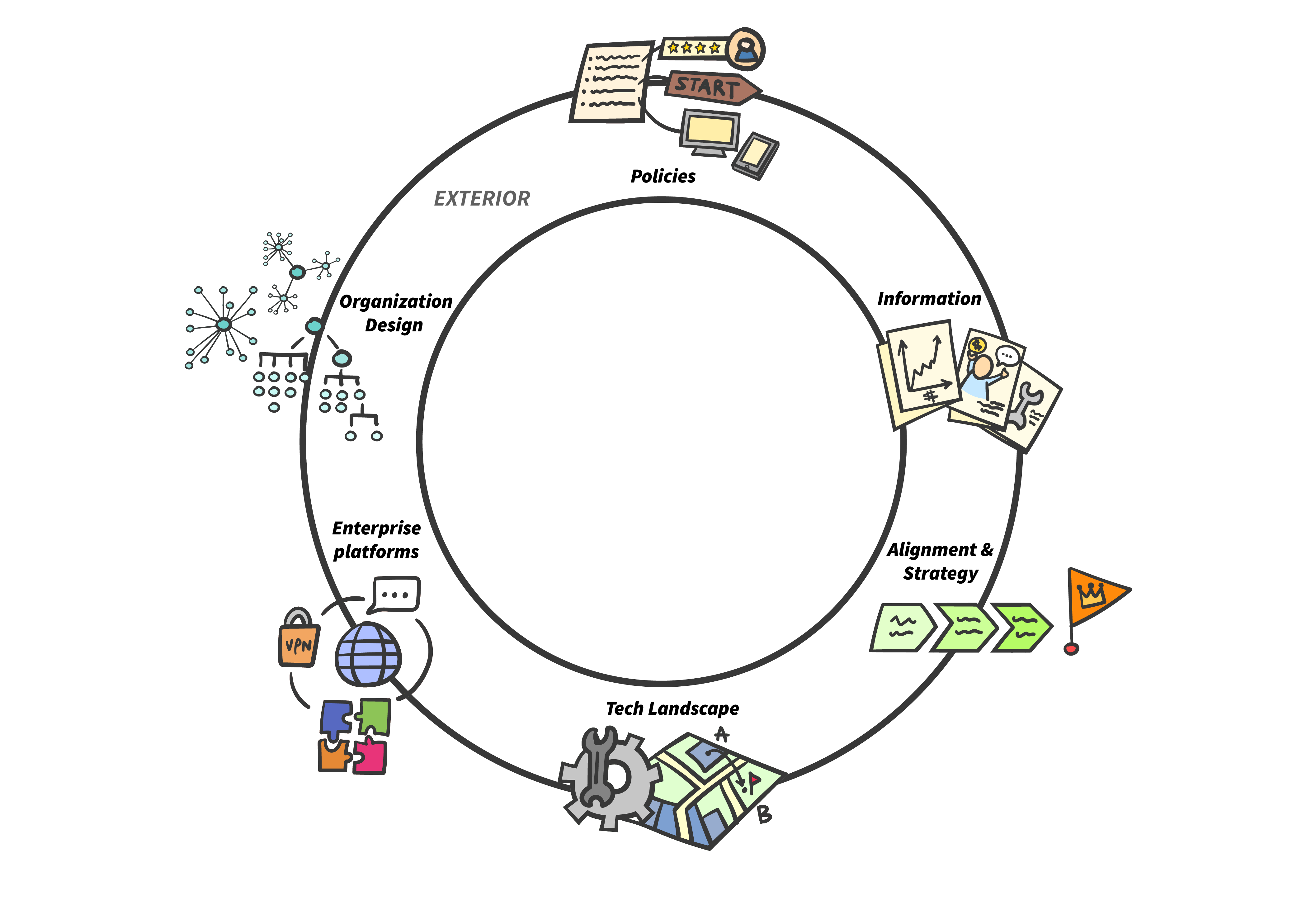 Team well-being and performance is heavily influenced by the environment. It is important to pay attention to the exterior conditions that your teams have, such as:
- Information. E.g. Availability of data, feedback loops (e.g. aggregated customer reports, technical reports, earning reports, costs, etc), information and insight taxonomy, insights platform
- Alignment & Strategy. E.g. Creation framework (e.g. DIBBs, Kernel Strategy), deployment frameworks (OKR, North star), how work with strategy is done (i.e. push vs pull, cascading goals vs north star)
- Tech Landscape. E.g. Technology stack, deployment support, availability of internal services/libraries, internal integration points
- Enterprise Platforms (a.k.a IT platforms). E.g. Communication tools (teams, slack, google etc), collaboration tools (mural, miro, figma, trello, jira etc etc), VPN
- Organization Design. E.g. Organizational structures, team structures, role definition process
- Policies. E.g. New equipment, internal mobility, team setup, annual performance reviews
Applying the Holistic Observations of Teams
Using this framework boils down to getting a holistic view of all factors that affect team performance and well-being. Use it to get a picture of what factors work in favor, and what factors work against that. Then plan your actions with the right people depending on the insights that surface.
Internal vs. External Boundary
Depending on your company, the boundaries between the Interior and Exterior Perspective may be different. E.g. in a startup with two teams, there might not be a significant gap between the Interior and Exterior.
Consider whether there's a need to move the boundaries. E.g. Moving mandate from Interior to Exterior or vice versa. This might have a meaningful impact on team well-being and performance. We encourage you to update and define boundaries as necessary to fit your specific environment.
Taking an inside-out, or outside-in approach
You might wonder what perspective to begin with. That depends on your role.
If you’re working as an Agile Team Coach or Scrum Master, you’re likely going to take the inside-out approach. That is, first observe factors within the team’s Interior and then start looking at the environment from the Exterior Perspective.
If you’re coaching an organization with 50 teams, you're probably going to take an outside-in approach. First look at the Exterior Perspective, then focus on the Interior Perspective.
Regardless of what your starting point is, it's crucial to consider both perspectives in order to get a holistic overview.
Coach the team, coach management
Depending on the perspective that you are focusing on, consider who you need to involve and work with.
Observations about a team's Interior that aren't related to Exterior factors can be addressed within the team. But it is difficult for teams to change constraints and policies that impact many teams. To change those, you need to work with management.
Observe, don’t diagnose
We want to emphasize that this is a framework for observation and understanding, not for diagnosis. While it may be tempting to use this framework as a way to diagnose your team or environment, this is ultimately not why we created it. The purpose is to help ourselves discover areas we were not paying attention to.
Get permission first
As with all coaching, permission must come first. Work to create an agreement on what you're exploring and get the systems explicit permission to be observed.
Adapt the framework to suit your needs
We also want to point out that this is an adaptable framework, and we encourage you to adapt it to your situations and environments as necessary. If you feel you’re missing an area that’s important for your context, add that area. Similarly, if an area is not important for your context, remove it from the visualization.
Note: This article is co-written by Stefan Lindbohm and I. You can also find this article on his blog.
One Comment
Pingback: